History-Periods
Past eras

From pre-history to today
Choose your period

Periods of History
explore the different eras
Past eras
Choose your period
explore the different eras
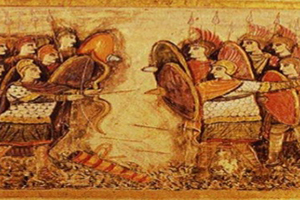
The Battle of Badon is a historical event that is believed to have taken place in England in the late 5th or early 6th century. It is a significant event in the history of England, as it is thought to have been the final battle in a series of conflicts between the native Britons and the invading Anglo-Saxons.
While the exact date of the battle is not known, it is generally believed to have taken place around the year 500 AD. The battle was fought between the forces of the Britons, led by a king named Arthur, and the invading Anglo-Saxons, who had been steadily encroaching on British territory for several decades.
The exact details of the battle are not known, and much of what is known about it comes from later accounts and legends. According to these accounts, Arthur was able to rally the Britons and lead them to victory over the Anglo-Saxons, effectively halting their advance and securing the future of Britain as a distinct entity.
Some historians believe that the Battle of Badon may not have been a single, decisive battle, but rather a series of conflicts that took place over a period of several years. Nonetheless, it is generally regarded as a turning point in the history of England, marking the end of the period of Anglo-Saxon expansion and the beginning of a new era in which the Britons were able to assert their independence and identity.
The Anglo-Saxon invasion of Britain began in the late 5th century and continued for several decades. It is believed to have been driven by a combination of factors, including population pressures, resource scarcity, and the desire for land and wealth.
At the time of the invasion, Britain was inhabited by a Celtic-speaking population known as the Britons. The Anglo-Saxons, who came from what is now Germany and Denmark, were initially invited by the Britons to help defend against invading tribes from Scotland and Ireland. However, they soon turned on their hosts and began to establish their own kingdoms on British soil.
The Anglo-Saxons were pagan and brought with them their own customs, beliefs, and social structures. They also brought with them their own language, which would eventually develop into Old English, the precursor to modern English. Over time, the Anglo-Saxons would come to dominate much of Britain, establishing their own kingdoms and pushing the Britons to the fringes of the island.
The goals of the Anglo-Saxon invasion were primarily territorial and economic. They sought to establish their own kingdoms on British soil and gain control of the land, resources, and wealth that it provided. They also sought to spread their own culture and way of life, which would eventually become the dominant culture in Britain.
It is worth noting that the Anglo-Saxon invasion was not a single, unified effort. Rather, it was a series of separate invasions and migrations by various tribes and groups. As such, the motivations and goals of the invaders may have varied somewhat depending on the specific group in question.
Despite the lack of concrete historical evidence, the Battle of Badon has become an important part of English folklore and mythology. The story of King Arthur and his knights has been retold and adapted in countless books, movies, and television shows, cementing its place in the cultural imagination of the English-speaking world.
King Arthur is a legendary figure in British folklore and mythology. He is said to have been a great king who led the Britons in battle against the invading Anglo-Saxons in the late 5th or early 6th century. While there is no conclusive historical evidence to prove the existence of King Arthur, many historians believe that there may have been a real historical figure behind the legends.
The earliest references to King Arthur come from Welsh literature, where he is depicted as a hero and warrior who defends Britain against invaders. The first written account of King Arthur in English comes from a chronicle called the Historia Brittonum, which was compiled in the 9th century. The Historia Brittonum describes Arthur as a warrior who fought against the Anglo-Saxons, but it does not give many details about his life or accomplishments.
The most famous accounts of King Arthur come from medieval literature, including the works of Geoffrey of Monmouth, who wrote a History of the Kings of Britain in the 12th century. Geoffrey's work describes Arthur as a great warrior and leader who fights against the invading Saxons, establishes a vast empire, and rules over a golden age of peace and prosperity. Other medieval writers added to the Arthurian legends over time, including stories of his sword Excalibur, his wizard advisor Merlin, and his Knights of the Round Table.
While it is difficult to separate fact from fiction in the Arthurian legends, some historians believe that there may have been a real historical figure behind the stories. It is possible that there was a warrior or leader named Arthur who fought against the Anglo-Saxons, although the details of his life and accomplishments are likely to have been embellished over time. Some historians have suggested that Arthur may have been a Romanized Briton who fought against the Anglo-Saxons in the aftermath of the Roman withdrawal from Britain.
Despite the lack of conclusive evidence, King Arthur remains a powerful symbol of British identity and nationalism. His legend has inspired countless works of literature, art, and film, and his story continues to capture the imagination of people around the world.
The literary work is "Morte d'Arthur," which is a collection of Arthurian legends and stories compiled and written by Sir Thomas Malory in the late 15th century. The title "Morte d'Arthur" is French for "The Death of Arthur," and the work focuses on the latter part of King Arthur's life, including his final battle against Mordred and his death.
"Morte d'Arthur" is considered one of the most important works of English literature, and it has had a lasting impact on the popular perception of King Arthur and his legend. The work was written in Middle English and draws on a wide range of sources, including earlier Arthurian literature and historical accounts of medieval Britain.
The book is divided into eight "books," each of which contains multiple chapters or sections. The first part of the book focuses on the early years of Arthur's reign, including his acquisition of Excalibur, his marriage to Guinevere, and the establishment of the Knights of the Round Table. The latter part of the book deals with the decline and downfall of Arthur's reign, including the affair between Lancelot and Guinevere, the betrayal of Mordred, and the final battle between Arthur and his enemies.
"Morte d'Arthur" has been adapted and reinterpreted countless times over the centuries, in works ranging from Tennyson's "Idylls of the King" to modern film and television adaptations. Its influence on the popular perception of King Arthur and his legend is difficult to overstate, and it remains a beloved and important work of English literature to this day.
If you have a suggestion regarding additional topics you would like to see included - please let us know
Reference: Article by Greg Scott (Staff Historian), 2024