History-Periods
Past eras

From pre-history to today
Choose your period

Periods of History
explore the different eras
Past eras
Choose your period
explore the different eras
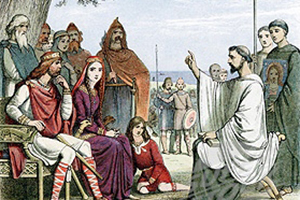
Pope Gregory the Great sent a monk named Augustine of Canterbury to England in 597 AD as the leader of the Gregorian mission to convert the Anglo-Saxons to Catholicism. Augustine of Canterbury was appointed as the first Archbishop of Canterbury and played a crucial role in establishing the Catholic Church in England.
The first event in England that is related to the Gregorian mission was the arrival of Augustine of Canterbury and his group of missionaries in 597 AD. They landed on the Isle of Thanet in southeastern England and were received by King Æthelberht of Kent, who was a pagan at the time. King Æthelberht allowed Augustine and his missionaries to preach Christianity in his kingdom, and many Anglo-Saxons were converted to the faith.
One of the first significant events in the establishment of the Catholic Church in England was the consecration of Augustine as the first Archbishop of Canterbury in 597 AD. This event marked the beginning of the organized Christian Church in England and the establishment of the See of Canterbury, which would become one of the most important centers of Christianity in England.
Another important event was the synod of Augustine, held in 602 AD, which marked the first assembly of the bishops of England and the beginning of the organization of the Church in England. This synod dealt with various issues, such as the conversion of the Anglo-Saxons and the establishment of the Christian faith in England.
Some of the significant issues and events in Augustine of Canterbury's life include:
Mission to England: Pope Gregory I sent Augustine to England in 597 AD with the mission of converting the Anglo-Saxons to Christianity. He arrived in Kent and was welcomed by King Æthelberht.
Conversion of King Æthelberht: Augustine was able to convert King Æthelberht and many of his subjects, which helped lay the foundation for the spread of Christianity in England.
Establishment of the first bishopric: Augustine established the first bishopric in England, which was based in Canterbury. He was appointed as the first Archbishop of Canterbury and became the head of the English Church.
Conflicts with the Celtic Church: Augustine faced opposition from the existing Celtic Church, which had different practices and traditions. He had to negotiate a boundary between the churches and resolve differences over issues such as the dating of Easter.
Miracles and Legends: Augustine was said to have performed several miracles during his time in England, which helped to increase his reputation and influence. Many legends and stories about his life and miracles were also recorded.
Death and Legacy: Augustine died in 604 AD and was revered as a saint. He is remembered as a major figure in the development of Christianity in England and is considered one of the founding fathers of the English Church.
Augustine of Canterbury believed in the importance of converting the Anglo-Saxons to Christianity. He saw it as his mission to bring the gospel to England and establish a Christian presence there. He was committed to this mission and worked tirelessly to convert the people of Kent and spread the faith throughout the country.
Augustine saw the conversion of the Anglo-Saxons as a way to bring them into the larger Christian community and help them lead more pious lives. He believed that the gospel had the power to transform individuals and society, and he was eager to share this message with the people of England.
In his efforts to convert the Anglo-Saxons, Augustine was mindful of their cultural and religious traditions and sought to find a way to integrate these into Christian worship and practice. He recognized that the conversion process would take time and patience and sought to build relationships with the people he was trying to convert.
The exact circumstances of Augustine of Canterbury's death are not well-documented and the information available is limited. However, it is believed that he died sometime around 604 AD. He is revered as a saint and his death was seen as a significant event in the history of the English Church. After his death, he was remembered as a major figure in the development of Christianity in England and as a pioneer of the faith in the country.
In the late 6th century AD, England was a collection of small, warring Anglo-Saxon kingdoms, many of which were still practicing pagan religions. Pope Gregory the Great, who was a renowned theologian and administrator, was concerned about the spiritual well-being of the Anglo-Saxons, and wanted to bring them into the fold of the Catholic Church.
Sending the Mission:
To accomplish this goal, Pope Gregory the Great decided to send a mission of monks to England to convert the Anglo-Saxons. The mission was led by a monk named Augustine, who was known for his learning and piety.
Augustine and his fellow missionaries arrived in England in 597 AD, landing in the kingdom of Kent. They were welcomed by the Kentish king, Ethelbert, who had recently married a Christian princess from the Frankish kingdom of Gaul.
Initial Success and Challenges:
The missionaries initially faced some challenges in their efforts to convert the Anglo-Saxons. Many of the people were deeply attached to their pagan beliefs and practices, and were suspicious of the new religion that the monks were promoting. Additionally, the monks had to contend with the language barrier, as they did not speak the local dialects of Old English.
Despite these challenges, the mission was successful in converting many Anglo-Saxons to Christianity. King Ethelbert himself converted to Christianity, and provided the missionaries with land on which to build a monastery and church in Canterbury.
The mission continued to spread throughout England over the next few decades, and new monasteries were established in other parts of the country. Augustine became the first Archbishop of Canterbury, and the Church in England became closely tied to the Church in Rome.
Impact:
The Gregorian mission had a profound impact on the religious and cultural history of England. The missionaries brought with them the Latin language, as well as Roman-style architecture and art. They also introduced new religious practices and ideas, such as the concept of the Trinity and the use of written texts in worship.
The Church played an important role in the development of English society, providing a sense of stability and order in a time of great political upheaval. The mission also helped to lay the foundation for the later spread of Christianity throughout Europe, as well as the development of the English language and literature.
If you have a suggestion regarding additional topics you would like to see included - please let us know
Reference: Article by Greg Scott (Staff Historian), 2024